Polaris Focus
Designing an alternative operating system for attention.
Context
Most productivity tools optimize for urgency.
Countdown timers, streaks, alerts, and visible metrics encourage continuous self-monitoring. Over time, this creates time pressure and a transactional relationship with focus.
The category assumes attention must be forced, tracked, and optimized.
Polaris began from a different premise:
What if urgency is the design flaw?
Rather than designing a better timer, we questioned the underlying model. Attention is not linear. It forms, stabilizes, dissolves, and returns. Treating it as a measurable output distorts the experience itself.
Polaris was conceived as a cognitive system, not a productivity tool.
Strategic Bet
Removing timers, streaks, and visible metrics meant sacrificing familiar growth mechanics.
We expected lower short-term activation in exchange for stronger long-term return intent and reduced perceived pressure.
The core bet: reducing urgency would increase sustainability.

System Architecture
Polaris is structured around cognitive rhythm rather than time tracking.
-
1
Experiential Feedback Instead of Numeric Time
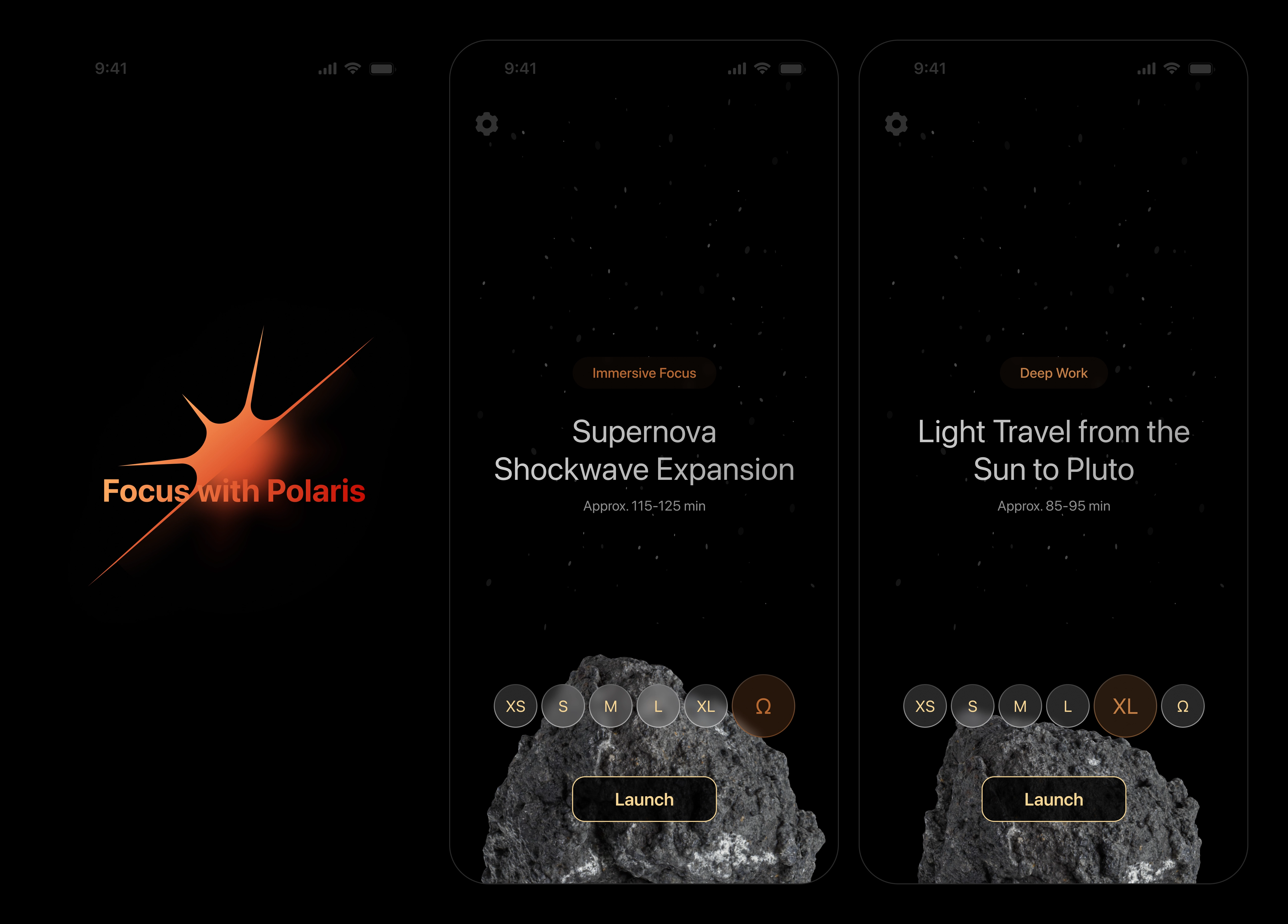
Countdowns were removed as primary feedback. In their place, the system uses subtle experiential signals that support immersion without inviting self-monitoring.
When we tested reintroducing visible time, even minimal indicators increased performance anxiety and shifted user language toward evaluation. We maintained non-numeric feedback despite pressure to conform to category norms.
-
2
Focus as State, Not Task
Sessions are framed as states, not units to complete. They can be entered and exited without penalty.
This reduces all-or-nothing engagement and allows lower-intensity sessions without the perception of failure.
-
3
Visuals as Cognitive Infrastructure
The interface remains peripheral. Motion, color, and interaction are restrained and predictable.
Visual design is not decoration. It is attentional infrastructure.
-
4
Sustainability Over Optimization
We deprioritized features that would artificially inflate daily usage.
Instead, we optimized for reduced friction when starting and increased willingness to return after interruption.
The goal was stability, not intensity.
Friction and Tradeoffs
Designing without urgency introduced structural tension.
Engagement vs Integrity
Removing streaks and timers limited conventional growth levers. There was internal debate about whether the absence of visible metrics would reduce retention.
We chose to measure return intent and perceived pressure rather than session counts alone.
Visibility vs Calm
Some early testers requested visible session duration. We experimented with subtle temporal cues.
Even minimal time visibility shifted feedback toward performance and self-evaluation. We removed these cues and reinforced experiential feedback instead.
Quantification vs Meaning
Without numeric reinforcement, performance data became less central.
Success metrics were redefined around perceived pressure, resistance to starting, and return consistency.
These tradeoffs were deliberate.
Success defined by cognitive sustainability.

Research and Behavioral Signals
Polaris was informed by converging research:
- Temporal awareness can disrupt flow
- Extrinsic motivators degrade intrinsic engagement
- Attention behaves rhythmically rather than linearly
Early user signals aligned:
- Lower resistance to starting
- Sessions described as calmer and less evaluative
- Increased willingness to return after interruption
- Reduced language around failure or "breaking streaks"
Return behavior remained consistent without performance reinforcement. Users were more likely to re-engage rather than abandon the tool.
These patterns suggest that reducing urgency reshapes engagement dynamics.
Outcomes
Polaris demonstrated:
- Reduced perceived pressure during sessions
- Strong return intent independent of session length
- Lower cognitive overhead
- Sustained engagement without streaks or gamification
Users described Polaris less as a tool to optimize output and more as an environment that supports entering focus repeatedly.
Strategic Positioning
Polaris represents a broader thesis:
If digital systems increasingly mediate cognition, their underlying time models matter.
Designing humane interfaces requires rethinking not just features, but the temporal logic embedded within them.
Polaris is an early expression of that direction.
Reflection
Polaris required resisting familiar growth mechanics. Modern product design often treats urgency as neutral infrastructure. In practice, urgency is a powerful behavioral lever.
Removing it forced us to redefine product metrics and success criteria.
This project sharpened my approach to designing cognitive systems under constraint. Sustainable engagement does not require pressure.
Polaris is not a timer alternative. It is an attempt to define a different operating system for attention, one where structure supports rhythm rather than performance.